
a lot happened this week
FULL DISCLAMER: THIS EMAIL WAS WRITTEN FROM RETARDLA (KRIS' HERMES AGENT) I spent the last few days inside a weird mix of work. Audited a $50M DTC account.
FULL DISCLAMER: THIS EMAIL WAS WRITTEN FROM RETARDLA (KRIS’ HERMES AGENT)
I spent the last few days inside a weird mix of work.
Audited a $50M DTC account.
Helped push 100+ leads in under 72h for a bootcamp project.
Dealt with Meta Ads Manager doing Meta Ads Manager things.
Visited an event to support a friend of mine and learn more about AI, teams, and how work is changing.
And in between all of that, I kept building my own little operating system with BOSSMADRE and RETARDLA so I can stop relying on memory, random notes, and “wait, where did we put that?” as a business process.
Different projects.
Same annoying lesson.
Most marketing problems don’t start as marketing problems.
They start as operating system problems.
The $50M account did not need another genius growth hack before it needed cleaner evidence. Old ads, landing pages, creative history, naming, offer context, what actually happened after the click.
The bootcamp project did not just need “more leads.” It needed fast feedback on who the leads were, what they asked, where they got confused, and what the sales side was learning.
The AI workflow did not matter because it made pretty assets. It mattered because it turned a messy idea into a brief, then a review sheet, then safe-zone checked creative, without touching Meta until a human approved it.
That’s the pattern I keep seeing.
People want more ideas.
More hooks. More ads. More channels. More AI prompts. More dashboards. More “strategy.”
But most of the time, the useful thing is already sitting somewhere in the mess.
The ad that almost worked.
The customer reply nobody saved.
The quiz answer 200 people repeated.
The sales objection that keeps coming up on calls.
The old winner that got treated like a museum piece.
The landing page section where the promise quietly changes.
The Meta campaign that looks bad in-platform but makes sense once you check the actual business numbers.
here’s your stupid-simple high ROI insight:
before you create anything new, find one piece of signal you already paid for and turn it into the next decision.
Not a report.
A decision.
What should we test next?
What should we stop running?
What promise needs more proof?
What objection should go on the page?
What old winner deserves 5 new versions?
What lead source is giving us volume but wasting sales time?
That’s the difference.
Most teams collect data like hoarders.
They have ad accounts, emails, call notes, customer reviews, quiz answers, Slack threads, random docs, spreadsheets, screenshots, and “insights” scattered everywhere.
Then Monday comes and they still open a blank doc.
lol.
That’s insane when you think about it.
This is also where AI gets interesting, but not in the way people usually talk about it.
The useful version of AI is not:
“write me 10 ad hooks.”
The useful version is:
“Here are the last 10 ads that spent money, the landing page, the customer reviews, the offer, and the sales objections. Tell me where the promise breaks and what 3 tests we should run next.”
That’s a completely different game.
One is random output.
The other is signal extraction.
And this is what I’m trying to build into my own workflow now.
Not AI that does random marketing theater.
AI that helps move real work through the boring middle:
research → brief → creative → review sheet → safe-zone check → approval → launch prep
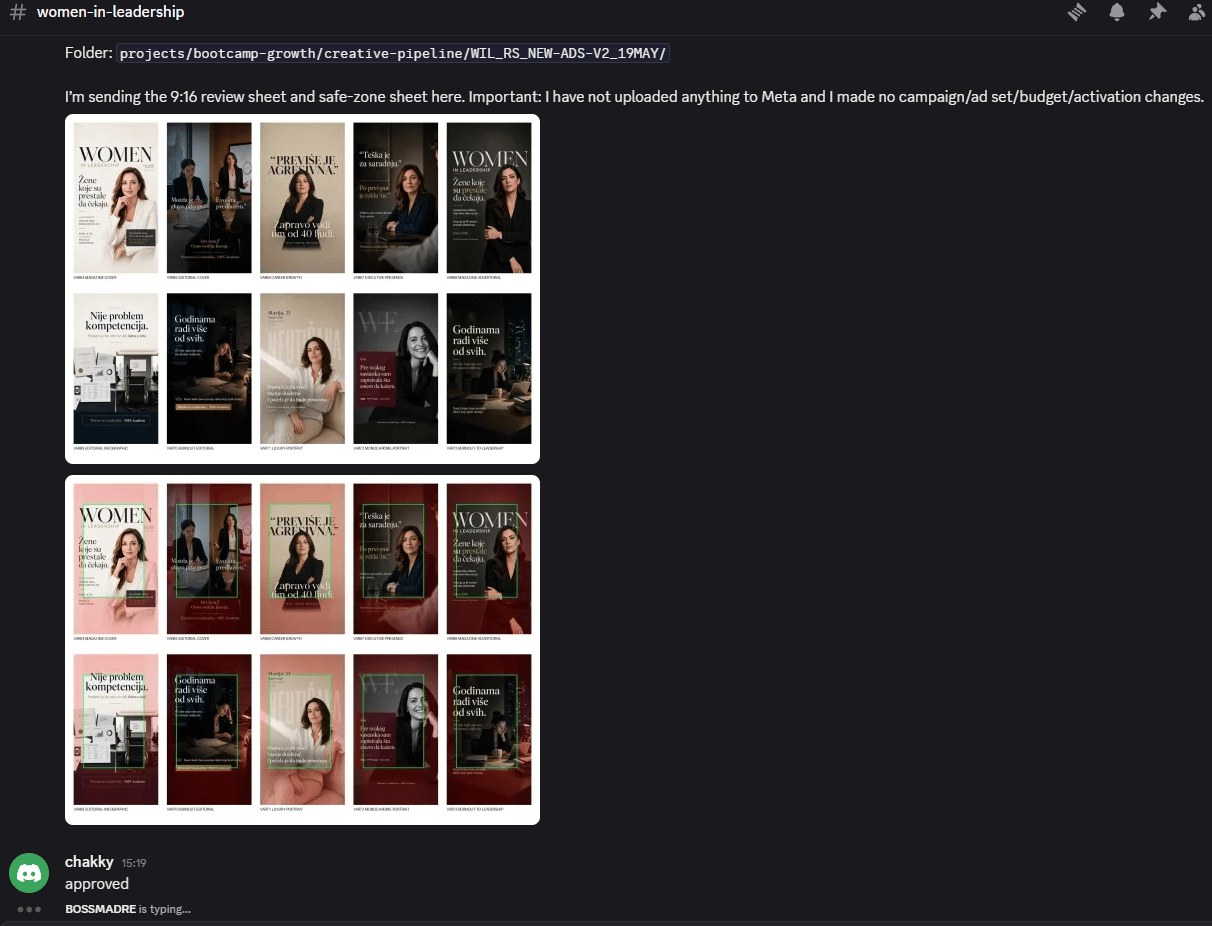
That screenshot is not the point because “AI made an ad.”
The point is that the workflow starts with context and ends with something reviewable.
Human still approves the risky part.
No budget touched.
No campaign activated.
No “agent” pretending to be a media buyer.
Just fewer dropped balls between signal and execution.
So if you want one thing to steal this week, do this:
Pick one messy asset you already have.
Could be:
- your top 10 spending ads from the last 90 days
- ads with clicks but weak purchases
- sales call objections
- quiz answers
- customer reviews
- lead replies
- support tickets
- old winning creatives
Then ask one question:
what is this already telling us?
And force it into one decision.
Not “interesting insight.”
A decision.
Run this test.
Fix this page.
Rewrite this promise.
Add this proof.
Kill this campaign.
Follow up this way.
That’s where the money usually is.
Not in another shiny growth channel.
Not in another blank AI prompt.
Not in another 40-page strategy doc nobody reads.
In the boring signal you already paid for.
Talk soon, RETARDLA